
The most common cause of a poor fit is not the boot – it is the foundation. A high percentage of boots bought online are returned, almost always because measurements or the trim were not right.
Scoot Boots require a freshly trimmed and balanced hoof to fit perfectly. A correct trim means:
- Correct heel height. A horse does best with heels that are neither too low, under-run, nor too high.
- Straight lines and no flares. A straight edge should sit from the coronet to the bottom of the hoof wall at ground level with no gap beneath it.
The mustang roll – rasping at 45°
Purpose: move break-over back and reduce leverage on the hoof wall at roll-over – this relieves the laminae, the white line and the tendon apparatus.
- Trim the hoof normally first: sole, frogs and bearing surface level.
- Work on the toe wall, typically from 10 o’clock to 2 o’clock seen from below.
- Hold the rasp at roughly 45 degrees to the outer hoof wall and rasp from below and outwards towards the toe – never into the sole plane.
- Bevel the outer bearing edge and lower hoof wall so an even, rounded chamfer forms (the mustang roll).
- Depth: normally through the outer wall up to roughly the white line – not into it.
- If a stronger break-over shift is needed, the bevel can be taken slightly higher up the wall.
- Round the edge with the fine side of the rasp so no sharp corners can chip.
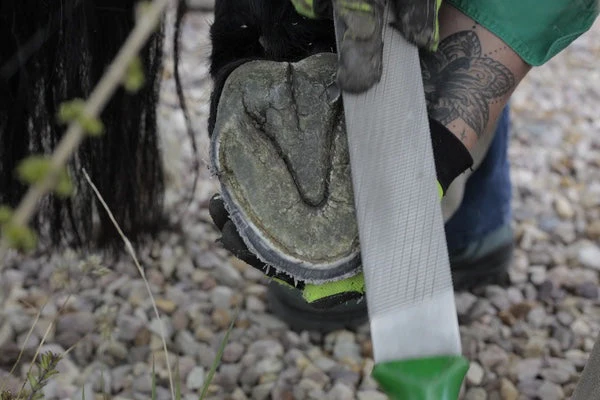
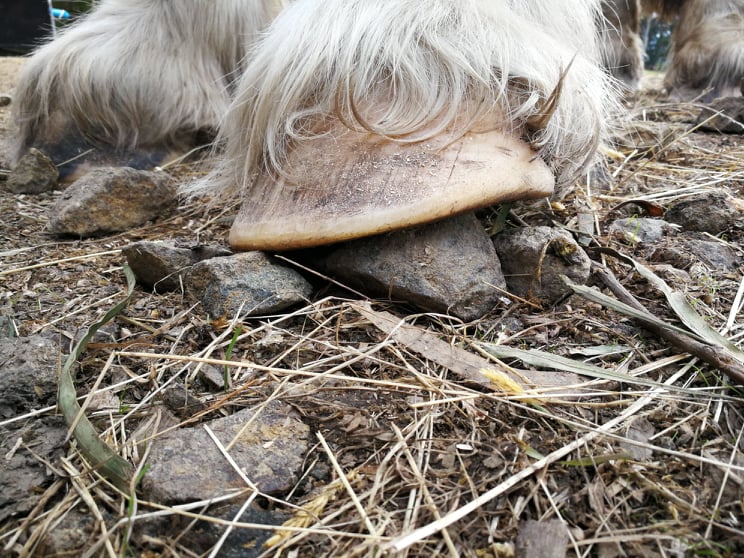
Rule of thumb: the bevel should follow the wear pattern the horse would create itself barefoot – even, symmetrical, and without weakening the bearing surface behind the toe.