
This is the story of how I came into contact with zeolite – and how it became the start of Total Support.
As an owner of quarter and paint horses with mostly white legs, including a horse with an autoimmune disease, I am always on the lookout for unwelcome plants, sun and insects that can lead to skin problems. I do my utmost to keep pastures, stables, stalls, feed and horses in the best possible condition.
My mare Myran has always been extra sensitive to sun and suffered from flaky skin on her legs during the summer, so in the fall of 2023 I visited Kerstin Bergvall (specialist in skin health SLU), where we took extended blood samples without abnormal findings.
A couple of months later, after wearing bellboots with sheepskin lining, small, small blisters appeared on both front legs. This became a gateway for bacteria and developed extremely quickly into skin problems such as mold and rashes. The legs swelled and we took further tests this time at Mälarens hästklinik in Sigtuna, which were analyzed in the lab. The results were not unusual; we found common bacteria and streptococci within the normal range.


The skin problems were treated in consultation with the veterinarian with penicillin, salicylic acid vaseline, alcogel, daily washes with hibiscus scrub, bandages, cotton wool, cortisone and antibiotic ointment. There were a few emergency visits to the vet (in addition to our scheduled visits) because it was impossible to approach her legs despite giving her dormosedan gel.


Ant was not allowed out when it rained and we were in a very rainy period which forced me to let her move around the riding arena as often as I could, until the day the skin started to fall off.


In further consultation with the vet, I continued with a milder treatment and increased the dose of cortisone. I spent 4-6 hours a day taking care of her legs, and the rest of the time my mind was occupied with trying to find a new treatment, a new ointment or a new answer.
The questions grew; how long should I continue? – Where do you draw the line? – Should I give up – Should I put her down?
All I could talk about were all my theories and recent advances with new products and ointments, hoping to get some input that would lead me towards new answers. My horse suffered – and so did I.
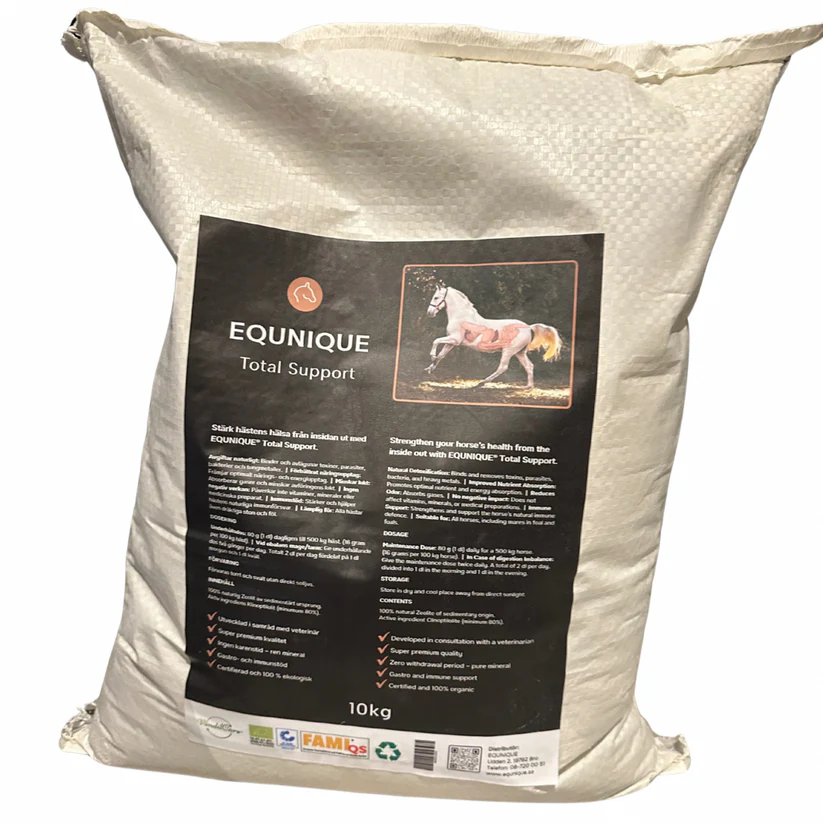
At this stage, I was given the number of Ola who started and runs VendilCare. One call later, and Ola comes over with 10 kg of zeolite (clinoptilolite).
I started giving her 2 dl of Total Support in her daily concentrate ration.
Zeolite is not a medicine, and Total Support is a feed supplement – not a treatment. Skin problems should always be assessed and treated by a veterinarian, and I advise no one to stop a treatment or go against their vet’s advice.
After this experience, we have found our red line and are developing more and more products containing Zeolite.